
Sortition - the most democratic form of governance you've probably never heard of (I hadn't)

Via a click to Ole Håvard, in the comments of Trafficking Science by trauma therapist, Valeria Petkova (highly recommended), cross-posted by The Hidden Life is Best, I came upon a word referring to a type of governance I’d never heard of although the English word, sortition, emerged in the late 1500s to describe any process of deciding an outcome or assigning a duty by chance, jury duty being one we are all familiar with. In Ancient Greece, however, the practice of random selection in governance and law extended beyond juries to selection of public officials - the specific process of drawing lots was often referred to as kyrōsis, and the specialized, randomized allocation machine used by the Athenians was called a kleroterion.
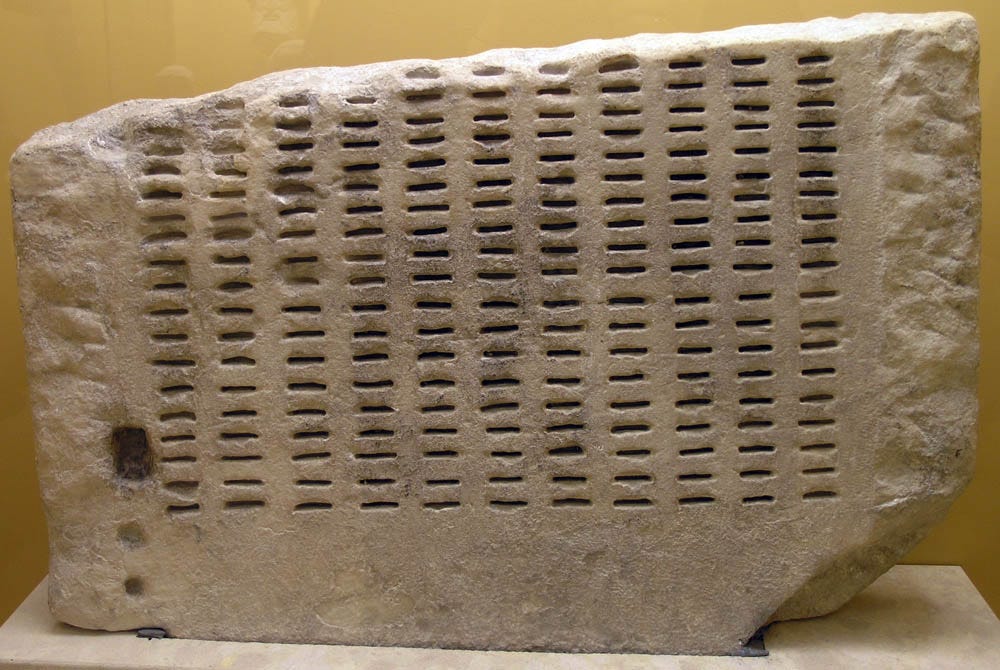
The brokenness of our current system of “democracy” is prompting an urging to resurrect this ancient system of selection of public officials and it has a lot to recommend it. A priori, it seems crazy that we use the term democracy, a form of governance that we recognise originated in Ancient Greece … and yet we don’t use the system for which the term is named.
The immediately obvious benefit of sortition is that it circumvents the representational problem of having political factions and interest groups.
Short take by Sortition USA who explains the counterintuitive notion that the reason that rich people control our governments is because of elections.
From Hugh Pope’s, Making sortition cool, trendy and fun, subway short take with British actor, Riz Ahmed.

After the death of his father, classicist, Maurice Hope, Hugh’s mother found a 30 year-old manuscript that Hugh and his brother edited with input from a new generation of democracy experts and published it as a book: The Keys to Democracy.
It flabbergasts me that we don’t learn of this type of governance at school and that it is generally unknown among the population.
Recommended
Democracy Creative by Terry Bouricius, “recovering politician (having served 20 years in elective office), who discovered the history and use of sortition and came to the startling conclusion that elections are not the best tool for running a democracy.” Free ebook, https://democracywithoutpoliticians.org
You only need a few leads … and you’ll find a wealth of material on the subject.
Caveat Emptor! This is very much favoured by the "Powers that Shouldn't Be" in the form of so called "Citizens Assemblies", a highly controlled process to give people the illusion that they can have a real say. Like everything else, you have to do the research: find out who is behind it and where their funding comes from. As always, follow the money
To our governors, the illusion of voting is important. They go to great lengths, countless people are involved in the counting process. But it is easily seen to be futile. One, most people haven't the time or inclination to research issues allegedly in question, and anyway, most likely the candidates have been screened so that none present any real challenge to existing power.
Prior to the age of electronic voting, it appears that the counting mechanism was working, so that in 1992 and 1996 in the U.S. Ross Perot was employed to run as a third party candidate and given tons of publicity, the end result the election of Bill Clinton with a minority of the vote. Perot took votes from Clinton's opponent. Clinton was the golden boy. Zbigniew Brzeziński claims to have spotted him and thought him fit to hold the office.
Then came 2000, Bush v Gore, the worst choice ever presented, and the advent of electronic voting machines as a result of a staged failure of paper ballots in Dade County, Florida. They were funded nationwide even as repeatedly shown to be easily hacked. They now are used in virtually every jurisdiction, so that any outcome can be altered to fit the needs of the governors.
Our elections were always managed, but the means of cheating on the results was made easier by the 2000 debacle. It eliminated the need to Ross Perot's and the like to run interference. S the old saying goes, if voting mattered, it would be illegal.